IBM Sales Manager Support
Globally upskilling IBM sales managers in their roles.
- Timeline
- Jun–Jul 2021
- Role
- UX Design Intern
- Platform
- Web


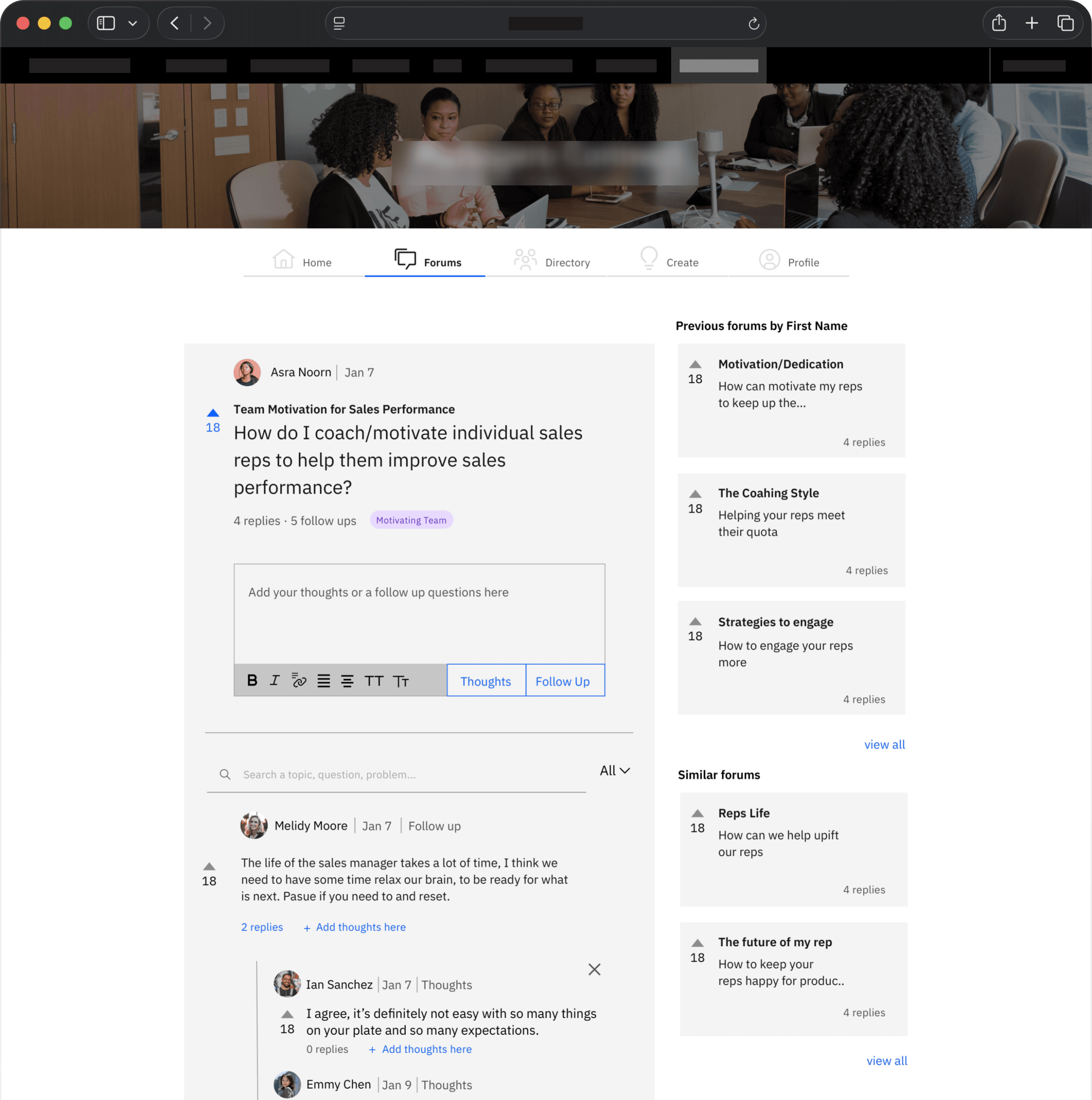
The screens and prototype from this project are IBM intellectual property and protected by confidentiality. What follows shares the process and a limited glimpse of the solution rather than the full deliverables.
Customer problem
IBM's first-line sales managers juggle people, business, and client responsibilities — yet the know-how that helps them do the job well lives in their heads or scattered across too many platforms. When a manager hit a problem a peer had already solved, there was no shared, searchable place to find that answer or the person behind it.
Our sponsor team — IBM's Global Markets, Sales Enablement group — asked us to explore a community space where managers could create, share, and consume content. As our research deepened, the customer problem evolved: How might we help sales managers to easily collaborate, seek support and resources, and build community?
“There's just a lot of knowledge that people have that they are not necessarily sharing, and I think we don't have a good place to do that as managers.”
“IBM does not lack putting materials out. The question is 'how … do you find it?' If it takes me two hours to go and find a presentation, I'm not going to use it.”
Outcome
We delivered a high-fidelity, interactive prototype — a single web-based platform where sales managers can search for resources, exchange knowledge in a variety of formats, and reach managers beyond their immediate circle.
We also created an experience-based roadmap to guide the product after handoff. In the handoff process, we presented a final playback of the product to the Global Sales Enablement team, IBM's Vice President of Design, and other stakeholders. The sponsor team took the work to its next step, pitching it to leadership within Global Sales Enablement to fund development.
My role
As one of four UX and research interns partnered with an IBM sponsor team, I co-facilitated 8 of our 15 user interviews and usability testing sessions, and collaboratively turned the findings into the insights, need statements, and early-stage ideation that shaped the product's direction.
In high fidelity, I honed in on the Forum and Directory experiences, translating our usability findings into polished flows in IBM's Carbon design system. Throughout, I stayed aligned with the team to keep the product cohesive end to end.


Research
We grounded the work in Enterprise Design Thinking — first building domain knowledge about how sales management works at IBM, then diving into user research. Across the project we ran 15 user interviews spanning three phases — initial interviews, concept testing, and three usability tests — with managers across six countries and tenures from a few months to over 20 years, 8 of which I facilitated. We conducted a concept-testing survey to widen input.
What the research revealed
Key design decisions
As we moved into high fidelity, I focused on three decisions that helped managers find the right people, conversations, and content quickly — while staying consistent with IBM's Carbon design system.
Making the right mentor findable for any manager
Research showed managers rarely gained perspective beyond their immediate team. The product's Directory makes the whole community searchable, so a manager can find the right person by industry, openness to mentorship, years in role, and recent activity — a targeted way to reach mentors they'd otherwise never meet.
Making great answers rise and stay found
As the forums grow, the most useful answers and important threads should remain surfaced to keep them from getting lost. Upvotes raise the most helpful replies, and topic tags keep threads scannable and searchable. Authors can mark a question answered — pointing mentors to people still stuck — and a “tagged in” filter gathers the forums you're mentioned in, so replies aren't missed.
Threading content to relevant conversations around it
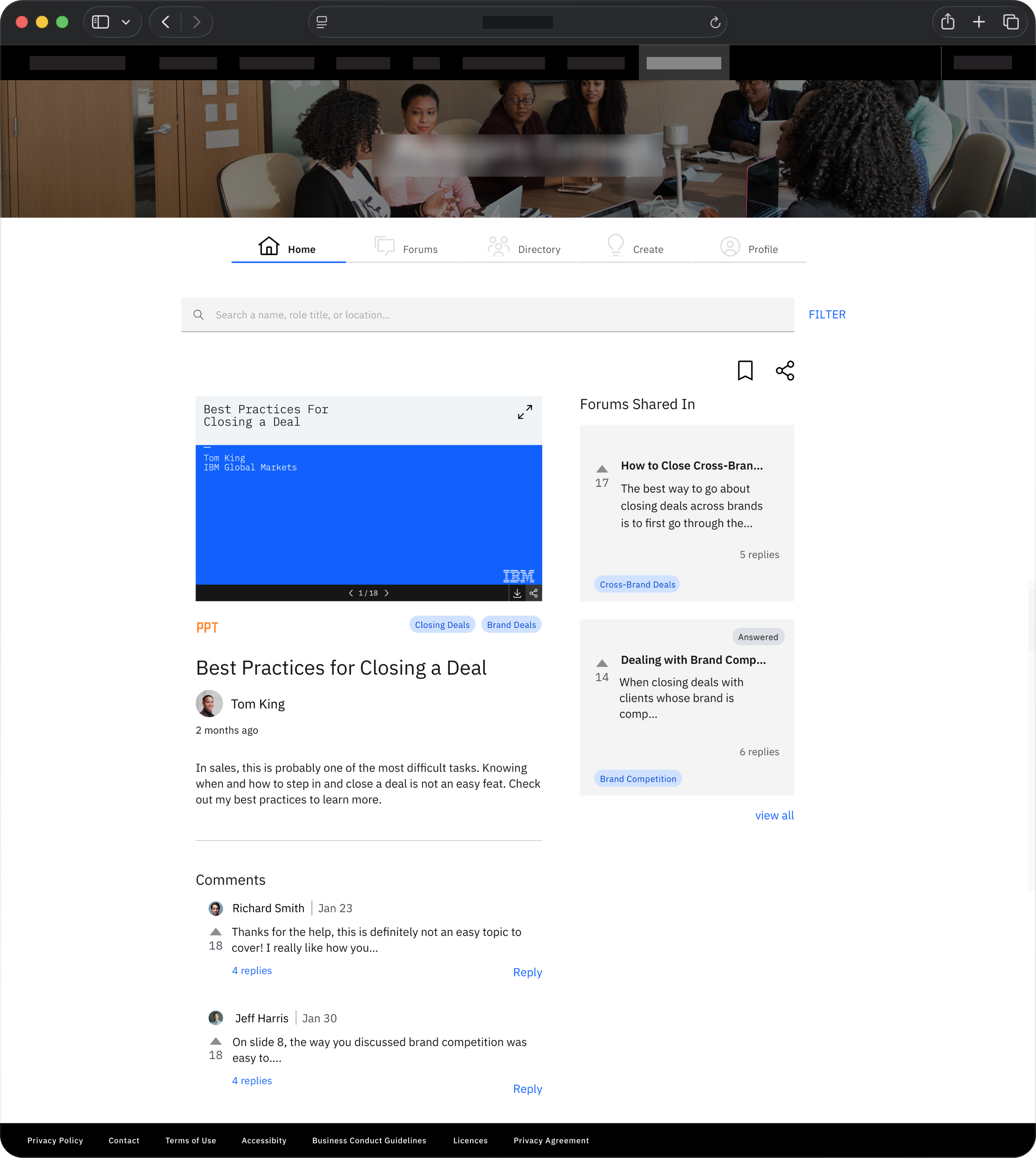
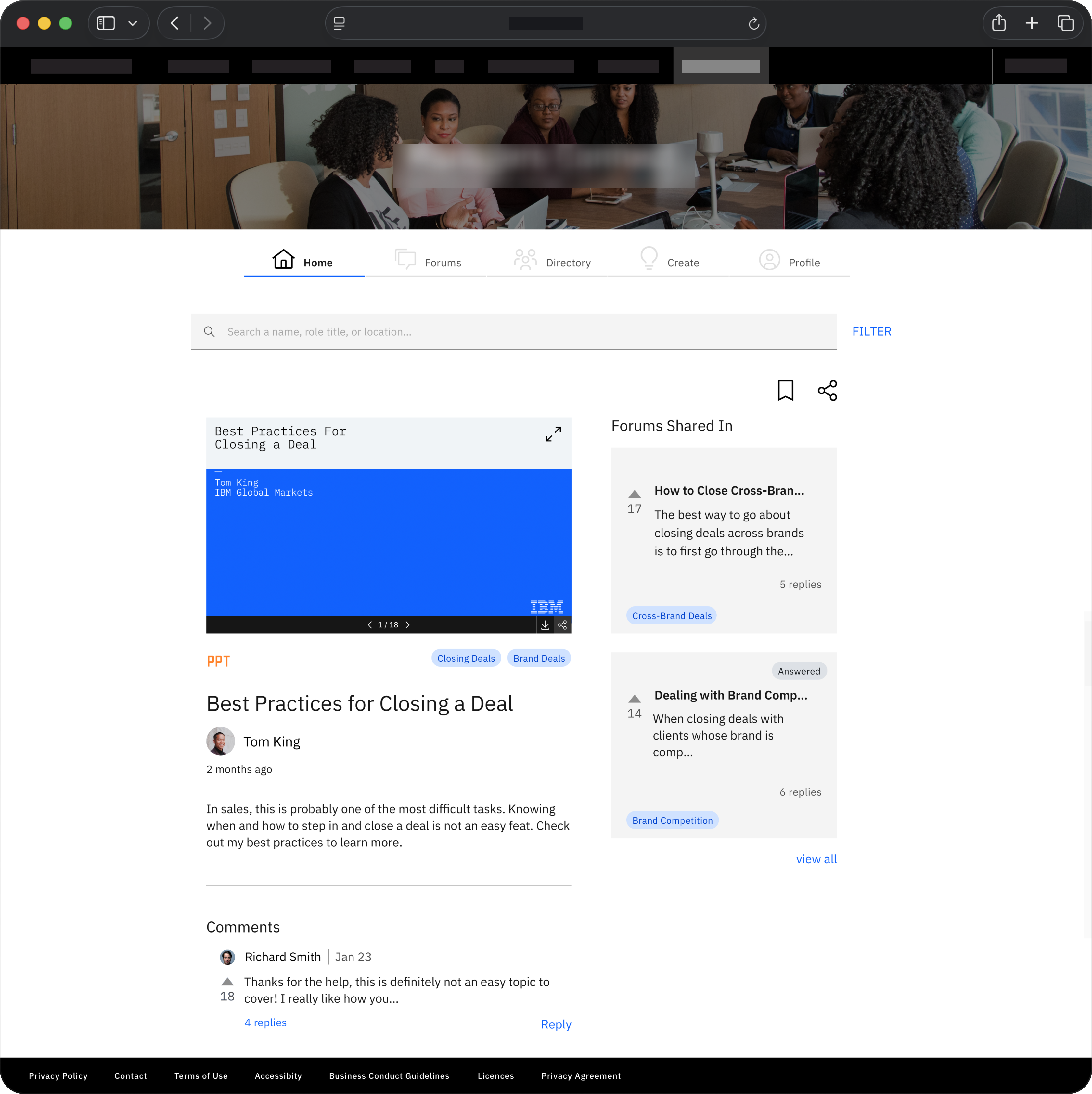
Research clearly illustrated that managers don't have time to dig through information. On every piece of content, the forums where it had been shared are surfaced — to act as a breadcrumb back to the conversations it lived in. If a piece is useful, the discussions around it likely are too — turning a single result into a doorway to related help instead of another search.
Conclusion
As my first UX Design internship designing within a mature, enterprise-scale design system, this project sharpened how I ground decisions in research, translate findings into polished flows, and present design work to leadership.
I'm proud that the sponsor team is carrying the work forward — pitching it to leadership in Global Sales Enablement to fund development — with the potential to help sales managers across IBM feel more supported in a demanding role. With more time, I'd broaden the research beyond the markets we reached, and A/B test variations of our solution with users.
Below highlights the feedback we received from our sponsor team.